246webagency
[ad_1]
Hurricane Ian was rapidly intensifying Monday as the massive storm hurtled toward Cuba and Florida, prompting a swath of hurricane watches and the first evacuations along Florida’s west coast.
More evacuations are expected as Ian draws closer. Florida Gov. Ron DeSantis said Ian is about 500 miles wide. The storm was moving northwest at 13 mph, about 240 miles southeast of Cuba, according to the National Hurricane Center. It has maximum sustained winds of 80 mph.

“Floridians up and down the Gulf Coast should feel the impacts of this,” DeSantis said Tuesday at the state Emergency Operations Center. “This is a really, really big hurricane at this point.”
Ian was forecast to intensify rapidly into a major hurricane, Category 3 or greater, as soon as late Monday, AccuWeather said. The storm could ultimately reach Category 4 status, which means sustained winds from 130 mph to 156 mph.
Where is Ian headed?
Ian was forecast to emerge over the southeastern Gulf of Mexico on Tuesday, pass west of the Florida Keys late Tuesday, and approach the west coast of Florida on Wednesday into Thursday. The storm is predicted to slow down during this period, the National Hurricane Center warned in an advisory.
“This would likely prolong the storm surge, wind and rainfall impacts along the affected portions of the west coast of Florida,” the advisory says, adding that “the roughly shore-parallel track still makes it difficult to pinpoint exactly what locations will experience the most severe impacts.”
‘CATASTROPHIC CATEGORY 4 HURRICANE?: Florida Gov. DeSantis declares state of emergency: What we know
Landfall in Florida likely for midweek
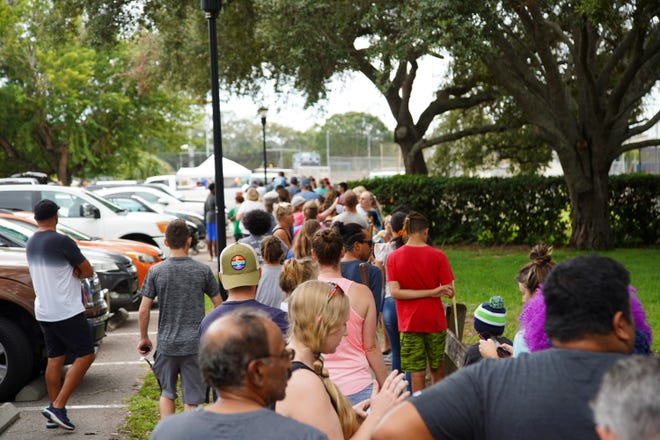
Landfall is increasingly likely in Florida midweek, AccuWeather said. Some evacuations were ordered Monday in coastal Hillsborough County, home to Tampa. The county suspended classes through Thursday to prepare schools to serve as shelters for evacuees.
“Please treat this storm seriously. It’s the real deal. This is not a drill,” Hillsborough County Emergency Management Director Timothy Dudley said Monday in Tampa.
Ian is expected to miss most of Cuba’s high, mountainous terrain that often disrupts tropical systems, allowing the storm to become a powerful Category 4 hurricane. What happens next will depend largely on the exact track Ian takes, according to AccuWeather. A southward dip in the jet stream across the United States will help pull the storm northward and into the coast.
“Just how quickly this interaction happens will determine the track of Ian, as well as how strong the system is when it reaches land,” AccuWeather said.
Florida preparing for storm
DeSantis, who has issued a statewide state of emergency, said an additional 2,500 Florida National Guard members were being called into duty, bringing the total to 5,000 – and 2,000 more are being deployed to Florida from nearby states. The state is working to load 360 trailers with over 2 million meals and more than 1 million gallons of water in preparation for distribution to areas of need. Urban Search and Rescue Teams are ready to mobilize where needed, DeSantis said.
“There is going to be an interruption of power, so just plan on that,” DeSantis said. “The impacts are going to be far and wide.”
NASA rolling spacecraft back into building
NASA will roll the Artemis I Space Launch System rocket and Orion spacecraft back into a building Monday after data gathered overnight “did not show improving expected conditions” for the Kennedy Space Center area, NASA said. The decision allows time for employees to address the needs of their families while also protecting the integrated rocket and spacecraft system. The launch, scheduled for Tuesday, was postponed because of the storm. Putting the spacecraft back into the Vehicle Assembly Building likely will further delay the launch.
Artemis is a first step toward establishing a sustainable presence on the Moon to prepare for missions to Mars.
Hurricane Ian tracker
Florida braces for Ian’s fury
The National Weather Service on Monday issued a hurricane watch along the west coast of Florida from north of Englewood to the Anclote River, including Tampa Bay. Florida Gov. Ron DeSantis declared a statewide state of emergency, urging residents to load up on food, water, medicine, batteries and fuel. He said it was too soon to determine when or where Ian will make landfall, but that evacuations may be ordered in coming days.
Bethune-Cookman University canceled classes Monday at its campus in Daytona Beach and said it would reconvene remotely on Tuesday.
“Expect heavy rains, strong winds, flash flooding, storm surge and even isolated tornadoes. Make preparations now,” he said Sunday. “Anticipate power outages. That is something that is likely to happen with a hurricane of this magnitude.”
STILL NO WATER OR ELECTRICITY: Voices from Puerto Rico after Hurricane Fiona
Category 4 storms can cause ‘catastrophic’ damage
If the storm struck as a Category 4 hurricane, it could cause “catastrophic” damage, and power outages could last weeks or possibly months, according to the National Weather Service’s description of storms that strong. Areas can be uninhabitable for weeks or months, the weather service says.
“Even if you’re not necessarily right in the eye of the path of the storm, there’s going to be pretty broad impacts throughout the state,” DeSantis warned.
Storm could drive heavy rains all week
Heavy rainfall is expected to affect North Florida, eastern portions of the Florida Panhandle, and portions of the Southeast, and mid-Atlantic regions into the weekend. Parts of west-central Florida will see the most: 8-10 inches across much of the area; some parts could see up to 15 inches.
“Considerable flooding impacts are possible mid-to-late week in central Florida given already saturated antecedent conditions,” the weather service warned. “Flash and urban flooding is possible with rainfall across the Florida Keys and the Florida peninsula through mid week.”
Limited flood impacts and rises on area streams and rivers are possible over northern Florida and portions of the Southeast mid-to-late week.
FLORIDA’S EAST COAST NOT IN CLEAR:Hurricane threat from Ian prompts preparations for flooding, power outages in Brevard
Florida’s west coast could take rare hurricane hit
AccuWeather meteorologists are warning that the storm could slam the west coast of Florida – an often-missed target. The U.S. database shows that about 160 hurricanes, excluding tropical storms, have affected Florida. Only 17 have made landfall on the west coast north of the Florida Keys.
Most storms typically travel northeast or northwest, not up the coast, AccuWeather senior weather editor Jesse Ferrell said. There is no record of a hurricane ever having tracked entirely up the west coast of Florida since records began in 1944. But Ian appears likely to take a “very unusual track,” he said.
Florida has been the target of recent storms that were hurricanes but were downgraded to tropical storms before landfall, Ferrell said. Elsa in 2021 made landfall west of Tampa, and Eta in 2020 made landfall north of Tampa in Cedar Key. Neither had the firepower close to a Category 3 storm, however.
Contributing: The Associated Press
[ad_2]
Source link